Volleyball Tryout Evaluation Form PDF: A Comprehensive Plan
Creating a robust volleyball tryout evaluation form in PDF format is crucial for objective player assessment. This document streamlines the process,
ensuring fairness and consistency during evaluations, ultimately aiding in team selection decisions.
A well-designed form captures essential player data and skill ratings, providing coaches with a valuable record for future reference and team development.
Utilizing digital PDF forms enhances efficiency, allowing for easy data compilation and analysis, while maintaining player information security.
Volleyball tryouts represent a pivotal moment for players aspiring to join a team, and for coaches building a competitive roster. A successful tryout isn’t simply about observing athletic ability; it’s a comprehensive evaluation process designed to identify individuals who possess the necessary skills, potential, and intangible qualities to contribute to team success.
The evaluation component is paramount. Utilizing a standardized volleyball tryout evaluation form PDF ensures objectivity and consistency in assessing each athlete. This form serves as a critical tool for coaches, enabling them to systematically record observations on various skills – serving, passing, setting, hitting, and blocking – alongside crucial intangibles like coachability, attitude, and leadership.
As highlighted in resources like the KC Fire Sample Tryout Plan, the goal extends beyond technical skills. Coaches aim to gauge communication effectiveness and assess these less tangible, yet vital, attributes. A well-structured tryout, coupled with a detailed evaluation form, is the foundation for building a cohesive and high-performing volleyball team.
The Importance of a Structured Tryout
A structured volleyball tryout, facilitated by a detailed volleyball tryout evaluation form PDF, is essential for fair and effective player assessment. Random, unstructured evaluations introduce bias and hinder the ability to accurately compare athletes. A pre-planned format ensures all participants are assessed under identical conditions, maximizing the validity of the results.
The KC Fire Sample Tryout Plan emphasizes the need for organization, offering timing and drill options to guide the process. This structure allows coaches to observe specific skills in a controlled environment, directly correlating observations to the evaluation form’s criteria.
Without a clear structure, crucial skills might be overlooked, or subjective impressions could overshadow objective data. A well-defined tryout, documented with a comprehensive PDF form, minimizes inconsistencies and provides a defensible basis for team selection decisions, fostering trust and transparency.
Key Skills to Evaluate During Tryouts
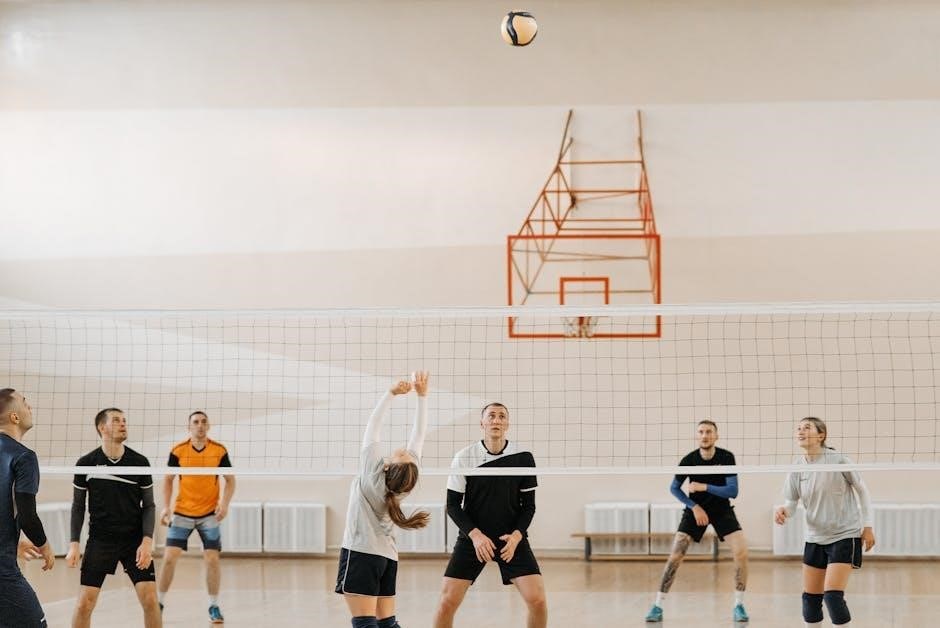
When utilizing a volleyball tryout evaluation form PDF, focusing on core volleyball skills is paramount. These include serving accuracy and consistency, crucial for initiating offensive plays. Assessing passing/digging technique and control determines a player’s ability to maintain possession. Setting precision and decision-making are vital for creating scoring opportunities.
Furthermore, evaluating hitting power, placement, and shot selection reveals offensive capabilities. Blocking effectiveness and timing demonstrate defensive prowess. The KC Fire Sample Tryout Plan highlights evaluating skills, communication, and intangibles.
The evaluation form should have dedicated sections for each skill, allowing for quantifiable ratings. Observing these skills during structured drills, and game-play scenarios, provides a holistic view of each athlete’s potential contribution to the team.
Serving Accuracy & Consistency
A volleyball tryout evaluation form PDF must thoroughly assess serving proficiency. Accuracy is judged by the percentage of serves landing in bounds, specifically targeting designated zones. Consistency refers to the repeatability of successful serves, minimizing errors. Coaches should note serve type – float, jump float, or topspin – and its effectiveness.
Evaluation drills should include serving from various distances, simulating game conditions. Metrics include total attempts, successful serves, and error types (net, out, ace). The KC Fire Sample Tryout Plan emphasizes evaluating skills during tryouts.
The form should include a rating scale for both accuracy and consistency, alongside space for qualitative observations regarding serve technique and strategic choices.
Passing/Digging Technique & Control
A comprehensive volleyball tryout evaluation form PDF needs a dedicated section for assessing passing and digging skills. Technique evaluation focuses on platform formation, body positioning, and footwork. Control is measured by the ability to consistently deliver a precise pass to the setter, maintaining a stable ball trajectory.
Drills should include reacting to various serve speeds and angles, as well as hard-driven attacks. The evaluation should note the player’s ability to read the attacker and anticipate the ball’s path. The KC Fire Sample Tryout Plan highlights evaluating communication skills.

Rating scales should assess technique, control, and reaction time; Coaches should also document observations regarding effort, court awareness, and ability to handle challenging digs.
Setting Precision & Decision-Making
The volleyball tryout evaluation form PDF must thoroughly assess a setter’s precision and decision-making abilities. Precision involves consistently delivering accurate sets, enabling hitters to attack effectively. Evaluation should consider hand technique, release point, and the ability to adjust sets based on passer quality.
Decision-making is critical; the form should assess the setter’s ability to read the block, identify the best hitting option, and distribute the ball accordingly. Drills should simulate game-like scenarios, testing quickness and adaptability.
Rating scales should cover location accuracy, tempo, and strategic choices. Coaches should note the setter’s composure under pressure and their ability to lead the offense, aligning with the KC Fire’s focus on intangibles.
Hitting Power, Placement & Shot Selection
A comprehensive volleyball tryout evaluation form PDF needs to meticulously evaluate hitting prowess. Assess power by observing jump height, arm swing speed, and ball velocity. However, raw power isn’t enough; placement is equally vital. The form should gauge the hitter’s ability to direct the ball strategically, exploiting weaknesses in the opponent’s defense.
Shot selection demonstrates volleyball IQ. Evaluate whether players choose appropriate shots – line, angle, tool, or roll – based on the game situation and blocking scheme. Drills should challenge hitters with varied sets and defensive setups.

Rating scales should cover power, accuracy, and smart decision-making, mirroring the KC Fire’s emphasis on skills and strategic thinking.

Blocking Effectiveness & Timing
A detailed volleyball tryout evaluation form PDF must thoroughly assess blocking capabilities. Timing is paramount; evaluate players’ ability to read the setter and opponent hitter, jumping at the optimal moment to create a solid block. Effectiveness goes beyond simply getting hands over the net.
Assess the blocker’s ability to close the block, angle their body to funnel the ball, and disrupt the hitter’s attack. Observe their footwork and lateral movement – crucial for adjusting to quick sets. The form should include ratings for block closure, reading the hitter, and overall block presence.
Considering the KC Fire’s focus on evaluating “intangibles,” note a player’s willingness to commit to blocking and their communication with teammates.
Components of a Volleyball Tryout Evaluation Form
A comprehensive volleyball tryout evaluation form PDF requires several key components for effective player assessment. First, a dedicated Player Information Section is vital, capturing name, position, contact details, and potentially years of experience.
Next, Skill-Specific Rating Scales are essential. These should cover serving, passing, setting, hitting, and blocking, utilizing a clear and consistent scoring system (e.g., 1-5 scale).
Crucially, include a Coach’s Comments & Observations section for qualitative feedback on technique, attitude, and potential. Finally, an Overall Potential Assessment provides a summary judgment, considering all evaluated factors.
As highlighted by the KC Fire sample plan, evaluating “intangibles” like coachability and leadership should also be incorporated into the form’s comment sections.
Player Information Section

The Player Information Section of a volleyball tryout evaluation form PDF serves as the foundational record for each participant. This section must include essential identifying details, beginning with the player’s Full Name, clearly printed for accurate record-keeping.
Further necessary fields encompass Date of Birth (for age verification), Contact Phone Number, and a reliable Email Address for communication.
Including the player’s Primary Position and Years of Volleyball Experience provides immediate context for evaluating their skill level.
Consider adding a field for School Name or Club Affiliation, and potentially a space for Parent/Guardian Contact Information, especially for younger athletes. Accurate data collection here streamlines the entire evaluation process.
Skill-Specific Rating Scales
Skill-Specific Rating Scales are the core of an effective volleyball tryout evaluation form PDF. These scales provide a standardized method for assessing player abilities across key areas. Employing a numerical scale (e.g;, 1-5, with 1 being poor and 5 being excellent) offers quantifiable data.
Separate scales should be dedicated to each skill: Serving (accuracy, consistency), Passing (technique, control), Setting (precision, decision-making), Hitting (power, placement), and Blocking (effectiveness, timing).
Clearly defined descriptors for each point on the scale are vital for inter-rater reliability. Consider incorporating brief qualitative notes alongside the numerical rating to capture nuances not reflected in the score alone.
Consistent application of these scales ensures a fair and objective evaluation process.
Coach’s Comments & Observations
Coach’s Comments & Observations represent a crucial qualitative component of the volleyball tryout evaluation form PDF. This section allows for detailed, personalized feedback beyond numerical ratings. It’s where coaches document specific strengths, weaknesses, and potential areas for development observed during drills and gameplay.
Observations should focus on technical aspects, tactical understanding, and, importantly, intangibles like effort, attitude, and coachability. Specific examples are invaluable – instead of “poor communication,” write “struggled to call for the ball during passing drills.”
This space facilitates a holistic assessment, capturing insights that rating scales alone might miss. These notes become essential when comparing players and making informed team selection decisions, providing context to the numerical data.
Overall Potential Assessment
Overall Potential Assessment within the volleyball tryout evaluation form PDF synthesizes all gathered data into a forward-looking evaluation. This isn’t simply an average of skill scores; it’s a judgment of the player’s capacity for growth and future contribution to the team.
Coaches should consider the player’s current skill level, coachability (from observations), attitude, and physical attributes. A player with raw talent but limited effort might receive a lower potential rating than a diligent player with moderate skills.
This section often includes a rating scale – for example, “High Potential,” “Moderate Potential,” or “Limited Potential” – accompanied by a brief justification. It informs decisions about team placement and individualized development plans.
Creating a PDF Volleyball Tryout Evaluation Form
Creating a PDF volleyball tryout evaluation form requires careful planning to ensure it’s both comprehensive and user-friendly. Software options like Adobe Acrobat and Google Forms offer distinct advantages. Acrobat provides robust form design features, while Google Forms excels in ease of use and data collection.
Begin by outlining essential fields: player information, skill-specific ratings, coach’s comments, and an overall potential assessment. Design the form with clear sections and logical flow. Utilize rating scales (e.g., 1-5 stars) for quantifiable data and ample space for qualitative observations.
Prioritize easy data entry – checkboxes, dropdown menus, and fillable text fields streamline the process. Consider digital signatures for form completion and ensure the PDF is accessible on various devices.
Software Options for Form Creation (Adobe Acrobat, Google Forms)

Adobe Acrobat remains a powerful choice for crafting detailed, professional PDF evaluation forms. It offers extensive customization, allowing for complex layouts, conditional formatting, and advanced security features. However, it typically requires a paid subscription and a steeper learning curve.
Google Forms presents a free, accessible alternative, particularly suited for simpler forms and quick data collection. Its intuitive interface and seamless integration with Google Sheets facilitate easy analysis. While less customizable than Acrobat, it’s ideal for teams prioritizing collaboration and ease of use.
Consider your team’s technical expertise and budget when selecting software. Both platforms enable the creation of effective volleyball tryout evaluation forms, but cater to different needs and preferences.
Essential Fields to Include in the PDF
A comprehensive volleyball tryout evaluation PDF must include key player information: name, date of birth, contact details, and playing experience. Dedicated sections for skill-specific ratings – serving, passing, setting, hitting, and blocking – are vital, utilizing clear rating scales (e.g., 1-5 stars).
Crucially, incorporate ample space for coach’s comments and observations on each player’s technique, decision-making, and overall performance. An “Overall Potential” assessment section allows for a holistic view.
Don’t forget fields for assessing intangibles like coachability, attitude, and leadership qualities. These subjective evaluations are critical for building a cohesive team. Ensure fields are clearly labeled and easy to complete.
Designing for Easy Data Entry & Review

Effective PDF form design prioritizes user-friendliness. Utilize clear, concise labels for each field, avoiding ambiguity. Implement dropdown menus or radio buttons for standardized skill ratings, minimizing free-text entry and ensuring consistency.
Strategic layout is key; group related fields logically. Employ sufficient whitespace to prevent a cluttered appearance. Consider using checkboxes for assessing intangibles like “Demonstrates Positive Attitude” or “Actively Listens to Coaching”.
For review, incorporate a summary section displaying key ratings at a glance. Ensure the PDF is easily searchable and allows for digital signatures for accountability. A well-designed form streamlines the evaluation process for coaches.
Tryout Drills & How to Evaluate During Each
Drills should mirror game-like scenarios to assess skills under pressure. During serving drills, evaluate accuracy, consistency, and serve type variation – noting scores on the evaluation form. Passing/digging drills reveal technique, control, and reaction time; observe footwork and platform angles.

Setting drills assess precision, decision-making (target selection), and hand technique. Hitting drills highlight power, placement, and shot selection, while blocking drills focus on timing, positioning, and net closure.
Game play scenarios provide insight into overall performance and teamwork. Coaches should use the evaluation form to record observations during each drill, focusing on specific criteria and providing detailed feedback.
Serving Drills & Evaluation Metrics
Serving drills should include a variety of serves: float, top-spin, and jump serves, if age-appropriate. Evaluation metrics focus on accuracy – percentage of serves in-bounds – and consistency, measured by successful serves within a set.
Assess serve speed and the ability to target specific zones on the court. Observe the server’s toss consistency and overall technique. The evaluation form should include a rating scale for each metric (e.g., 1-5, poor to excellent).
Note any significant weaknesses, such as a predictable serve pattern or difficulty with specific serve types. Coaches should also observe the player’s composure and ability to adjust after errors.
Passing/Digging Drills & Evaluation Metrics
Passing/digging drills should simulate game-like situations, including directed digs to targets and reacting to various attack angles. Evaluation centers on technique – platform formation, body positioning, and footwork – and control, measured by the accuracy of passes to the setter.
Assess the player’s ability to read the attacker and anticipate the ball’s trajectory. Observe their reaction time and quickness. The evaluation form should rate their ability to maintain a low center of gravity and consistently deliver a clean pass.
Note any struggles with fastballs, tips, or balls hit with topspin. Coaches should also observe the player’s communication and effort during drills, noting their willingness to pursue difficult digs.
Setting Drills & Evaluation Metrics
Setting drills should assess both technical skill and decision-making. Drills should include setting to different zones, setting after a pass, and quick sets after a dig. Evaluation focuses on hand technique – consistent contact point, proper finger spread, and smooth release – and accuracy, measured by the setter’s ability to deliver hittable balls.
Observe the setter’s ability to read the hitters and make appropriate setting choices based on the block and defensive positioning. Assess their tempo and consistency in delivering the ball.
The evaluation form should include ratings for location, height, and spin on the set. Note the setter’s ability to adjust to imperfect passes and maintain composure under pressure. Communication with hitters is also a key metric.

Hitting Drills & Evaluation Metrics
Hitting drills must evaluate power, placement, and shot selection. Implement approaches from different positions, hitting against a block, and hitting off-tempo sets. Assess the hitter’s arm swing – full range of motion, proper wrist snap, and consistent contact point – alongside their ability to generate power and control.
Observe shot placement, aiming for open areas and utilizing different shots (line, angle, tool). Evaluate the hitter’s ability to read the block and adjust their shot accordingly. Consistency in hitting with accuracy is paramount.
The evaluation form should rate hitting power, accuracy, and shot selection. Note the hitter’s ability to hit with pace and maintain composure under pressure. A hitter’s ability to terminate rallies effectively is a key metric.
Game Play Scenarios & Evaluation Metrics
Simulated game play provides a crucial context for evaluating players’ decision-making and skill application under pressure. Scenarios should include both offensive and defensive situations, mirroring real match conditions. Observe how players react to varying game tempos and opponent strategies.
Evaluation metrics should focus on court awareness, strategic thinking, and seamless skill integration. Assess players’ ability to transition quickly between offense and defense, communicate effectively with teammates, and make smart choices in critical moments.
The PDF form should include ratings for game IQ, adaptability, and overall contribution to team play. Note their ability to execute skills consistently within a game setting, demonstrating composure and strategic understanding.
Intangibles: Assessing Coachability, Attitude & Leadership
Beyond technical skills, evaluating intangibles is vital for building a cohesive and successful team. Observe players’ responses to feedback during drills and simulated game scenarios – a willingness to learn and adapt demonstrates coachability.
Positive attitude and effort are key indicators of a player’s potential. Note those who maintain enthusiasm, encourage teammates, and demonstrate resilience in the face of challenges. The PDF form should include a section dedicated to assessing these qualities.
Leadership qualities, even in a tryout setting, can be observed through communication, initiative, and the ability to motivate others. Assess their willingness to take charge and support their peers, contributing to a positive team dynamic.
Utilizing the Evaluation Form During & After Tryouts
During tryouts, the volleyball tryout evaluation form PDF serves as a real-time data collection tool. Coaches should complete sections immediately following each drill or game-play scenario, ensuring accurate recall of player performance.
Consistent use across all evaluators is crucial for maintaining objectivity. After the tryout, compile all forms for a comprehensive review. This allows for comparative analysis of players, identifying strengths and areas for development.
The completed forms become a valuable resource for team selection, informing decisions based on a holistic assessment of skills and intangibles; Retain these records for future reference, tracking player progress and informing training plans.
Legal Considerations & Player Privacy
When creating a volleyball tryout evaluation form PDF, prioritize player privacy and adhere to relevant data protection regulations. Obtain informed consent from players (or their guardians, if minors) before collecting any personal information.
Clearly state the purpose of data collection and how it will be used – solely for tryout evaluation and team selection. Limit the information collected to what is strictly necessary, avoiding irrelevant or sensitive details.
Ensure secure storage of completed forms, restricting access to authorized personnel only. Comply with any applicable data retention policies, and responsibly dispose of forms when no longer needed. Consult legal counsel to ensure full compliance with privacy laws.